
“Celebrating You” invites young creatives on a journey of self exploration through fashion, textiles and visual storytelling.
At the heart of the programme is the idea of the Hidden Force, the unseen strengths, emotions, memories, imagination, culture and creative energies that shape who we are and who we are becoming.
Through reflection, research, experimentation and making, students are encouraged to explore identity in their own way. Their responses can be personal, symbolic, emotional, cultural, conceptual or entirely imagined.
Fashion becomes more than clothing. It becomes a language for storytelling, transformation, emotion and human connection.
With support from one to one tutorials, each participant develops their ideas through a Learning Journal and a Final Artefact or Creative Fashion Outcome, documenting how an initial thought can evolve into a finished creative expression.
There is no single way to express identity, and no expectation of technical perfection. The programme celebrates authenticity, imagination, experimentation, cultural dialogue, personal growth and creative freedom.
Each participant interpreted their Hidden Force differently.
For some, it became a source of strength. For others, it emerged through cultural identity, activism, romance, imagination or freedom of expression.
Together, their projects show that identity is not one dimensional. It can be shaped by where we come from, what we believe, what we experience, what inspires us, and what we imagine ourselves becoming.
Fashion as Activism
For Mirella Porro, her Hidden Force is closely connected to her beliefs and her desire to speak openly about issues that matter to her.
Her project explores feminism, women’s rights and trans rights, drawing connections between fashion, activism, graffiti, rebellion and the punk movement. Inspired in part by the work of Vivienne Westwood, Mirella explored how fashion can become a platform for protest and social commentary.
Her design developed around a corset and a white and red colour palette. Red carries particular significance within the piece, representing both the menstrual cycle and the blood shed in the ongoing fight for women’s rights.
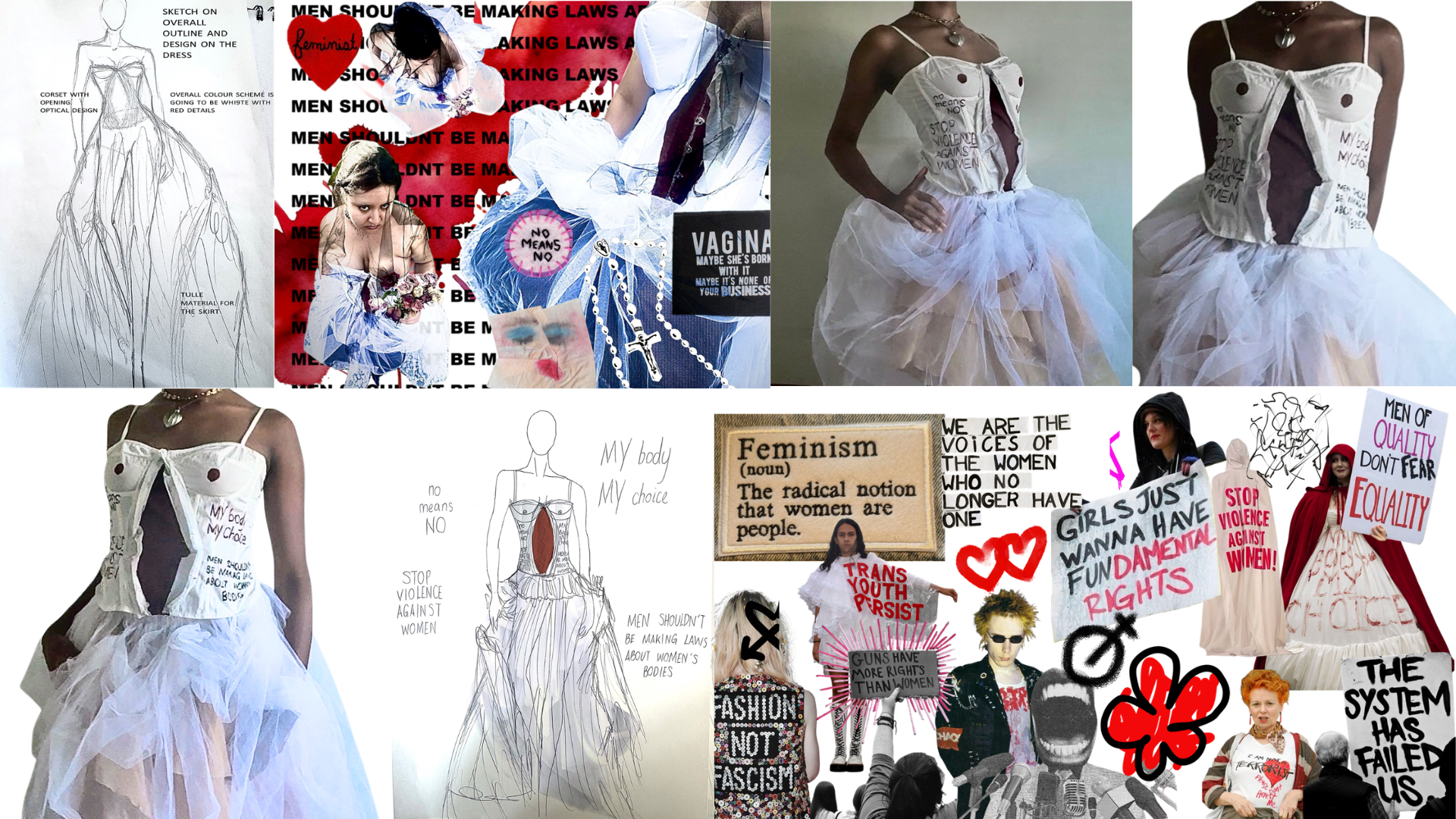
Feminist statements and protest messages are incorporated directly into the design, including ideas around bodily autonomy and the importance of listening when someone says no.
The final piece is more than a garment. Mirella presents it as a personal statement and an activist artwork, using fashion to bring ideas that should not remain hidden into the public space.
For her, creative expression becomes a way to make beliefs visible, challenge existing narratives and use fashion as a voice for resistance, equality and change.
Romance, Creativity & Transformation
Nicole Santos began her project by exploring heartbreak, relationships and the difficult emotions that can shape our experiences.
Her Hidden Force is her ability to transform challenging experiences into creative beauty. Creativity has been an important part of her life, from poetry and card making to fashion and personal creative projects, and she wanted to explore how this ability could become the foundation of her Commonwealth project.
Initially, Nicole imagined a piece centred on heartbreak and the painful side of relationships. But as the garment developed, the visual language began to move in another direction.
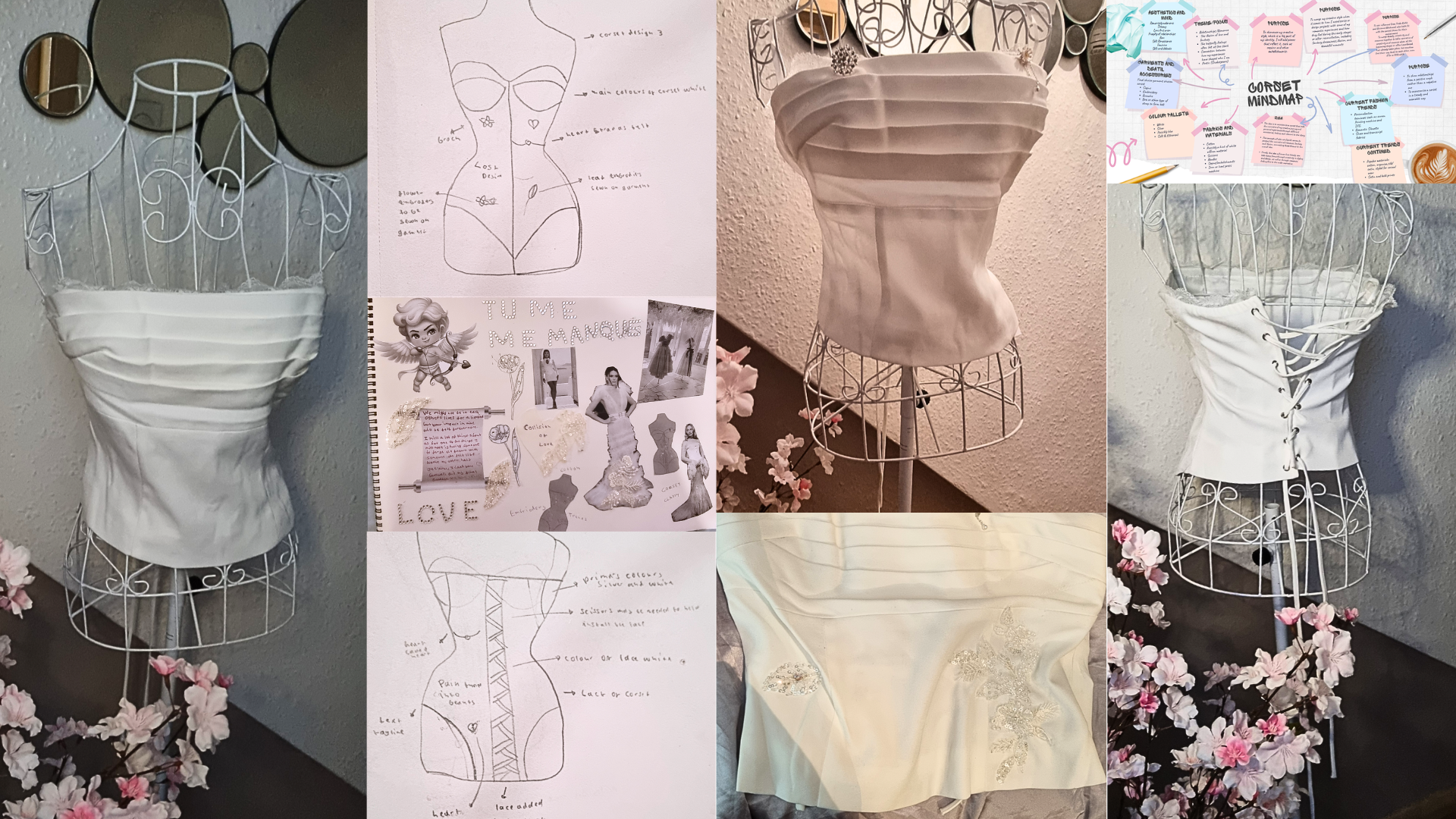
The corset became increasingly romantic, dreamy and delicate, leading Nicole to rethink the concept. Rather than forcing the garment to represent heartbreak, she allowed the creative process to guide her towards the positive side of romantic relationships: love, fantasy, excitement, beauty and the lasting memories they can create.
Her final corset incorporates embroidered flowers, sequins, a brooch, jewellery details and an angelic Cupid inspired motif. The word “love” is incorporated into the design, reinforcing its central theme.
Influenced by artists and designers including Frida Kahlo, Vivienne Westwood and Anna Bartoletti, Nicole also explored how personal experiences can be transformed into creative narratives.
Her final piece celebrates the beauty and fantasy of love, while recognising the difference between the idealised version we imagine and the reality we experience.
Strength Through Imperfection
For Anna Migacs, the starting point for her project was the Japanese philosophy of Kintsugi, the practice of repairing broken ceramics with gold.
Rather than hiding cracks and imperfections, Kintsugi highlights them, turning damage into part of the object’s history and beauty. Anna connected this idea with her own Hidden Force: resilience.
She translated this philosophy into a contemporary sculptural mini dress.
Her initial ideas explored a more straight forward skirt and transparent layers, but as the project developed, Anna realised that a more ambitious sculptural garment would communicate the concept more effectively.
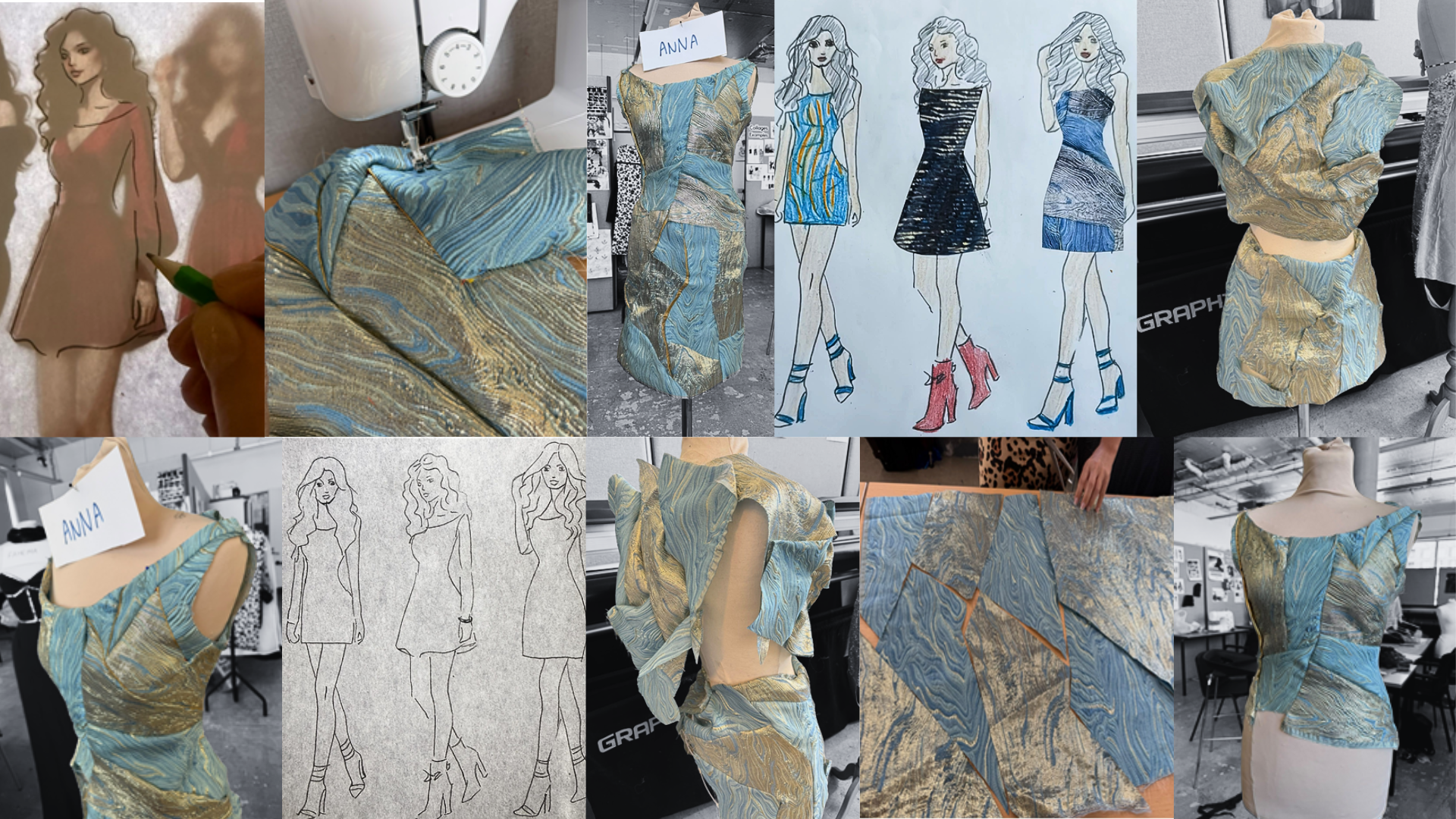
She moved towards a structured mini dress with a corset inspired bodice and an architectural, voluminous skirt. Traditional pattern pieces were replaced with irregular, organic shapes designed to resemble fragments of shattered porcelain.
Metallic blue and silver fabric was selected to reflect the glazed, light catching appearance of porcelain, while gold fabric and trim were stitched between the irregular pieces to represent the repaired cracks of Kintsugi.
Much of the garment was developed directly on the mannequin through draping, folding and experimentation, allowing Anna to refine the proportions and create a continuous sculptural form.
The final piece transforms imperfection into a visual strength.
Through fashion, Anna explores resilience, healing and transformation; suggesting that the things that have broken, changed or challenged us can become part of what makes us unique.
A Sense of Freedom
Rooted in her Japanese cultural identity, Moeka Maeda explored the idea of freedom through fashion.
Her research took her to Japan’s Taishō era (1912–1926), a period of rapid modernisation, cultural change and increasing Western influence. The emergence of the Modern Girl, or Moga, represented changing attitudes towards individuality, self expression and clothing.
Moeka became particularly interested in the moment when Japanese and Western clothing cultures began to coexist. Traditional kimono offered a strong connection to Japanese identity, while Western clothing introduced greater movement and practicality.
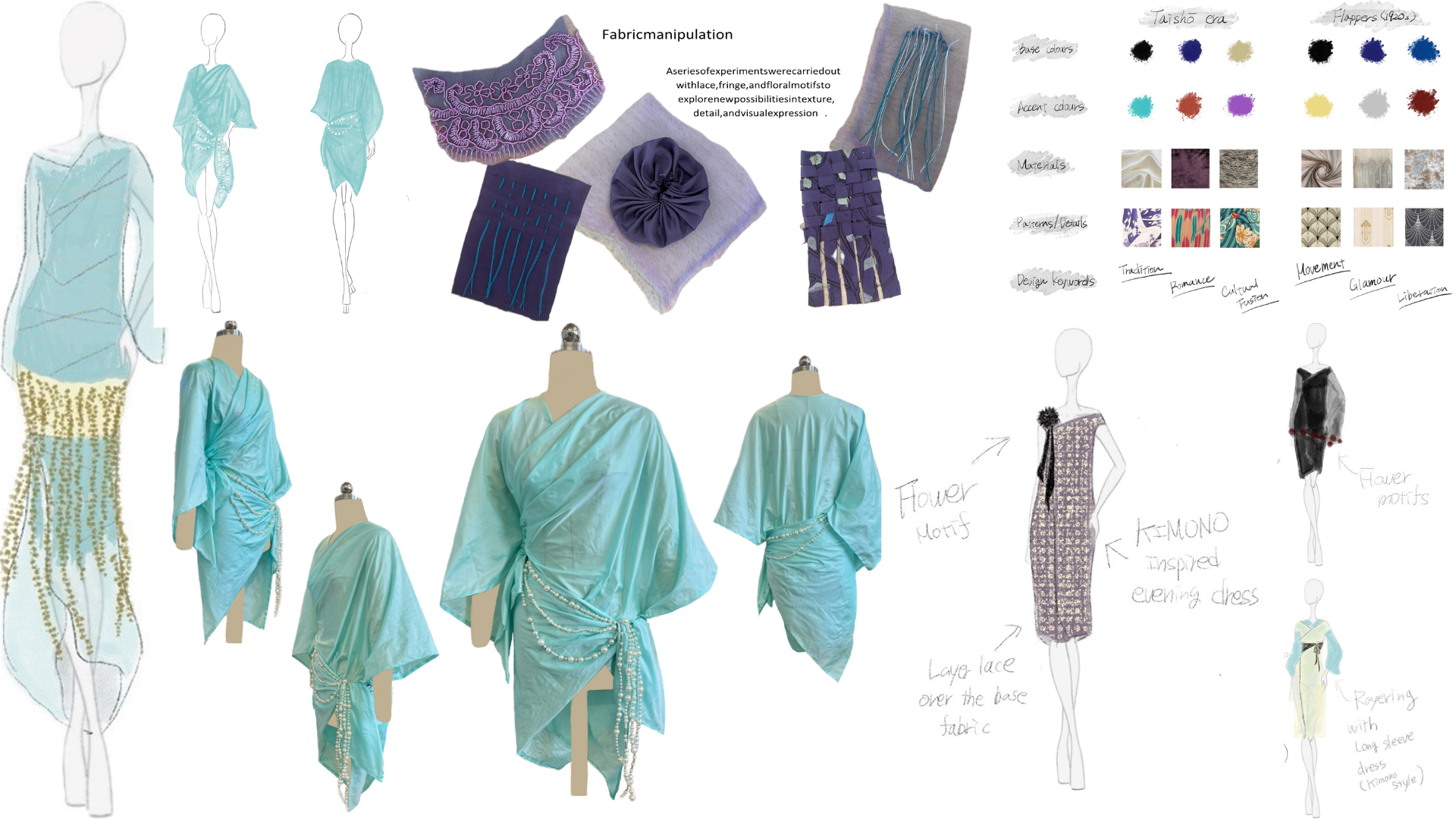
This cultural exchange became the foundation of her design.
Her final concept combines structural elements of the kimono with the silhouette and movement of the 1920s Western Flapper. A kimono inspired neckline and structure are combined with a lower waist and greater freedom of movement.
Glossy, semi sheer fabric, draping and decorative beadwork create a contemporary interpretation of the two influences, while experiments with lace, fringe and floral motifs helped Moeka explore texture and visual expression.
The result reflects her exploration of tradition, modernity, cultural exchange and liberation, showing how fashion can become a space where different cultural influences meet and create something new.
Freedom of Expression
Fahema Mohammad’s project explores freedom of expression through imagination and visual culture.
Her creative influences span K-pop, anime, gaming, fashion, food, Italy and Bangladesh, creating a broad visual world from which she could develop her own ideas.
The colour blue became particularly significant throughout her exploration. Her research connected blue with ideas including peace, calm, divinity, royalty, the galaxy, the sea meeting the sky, blue tulips and lapis lazuli.
Rather than settling immediately on one idea, Fahema’s project evolved through experimentation. Early concepts explored shells and feathers before developing through visual experimentation and AI generated elements.
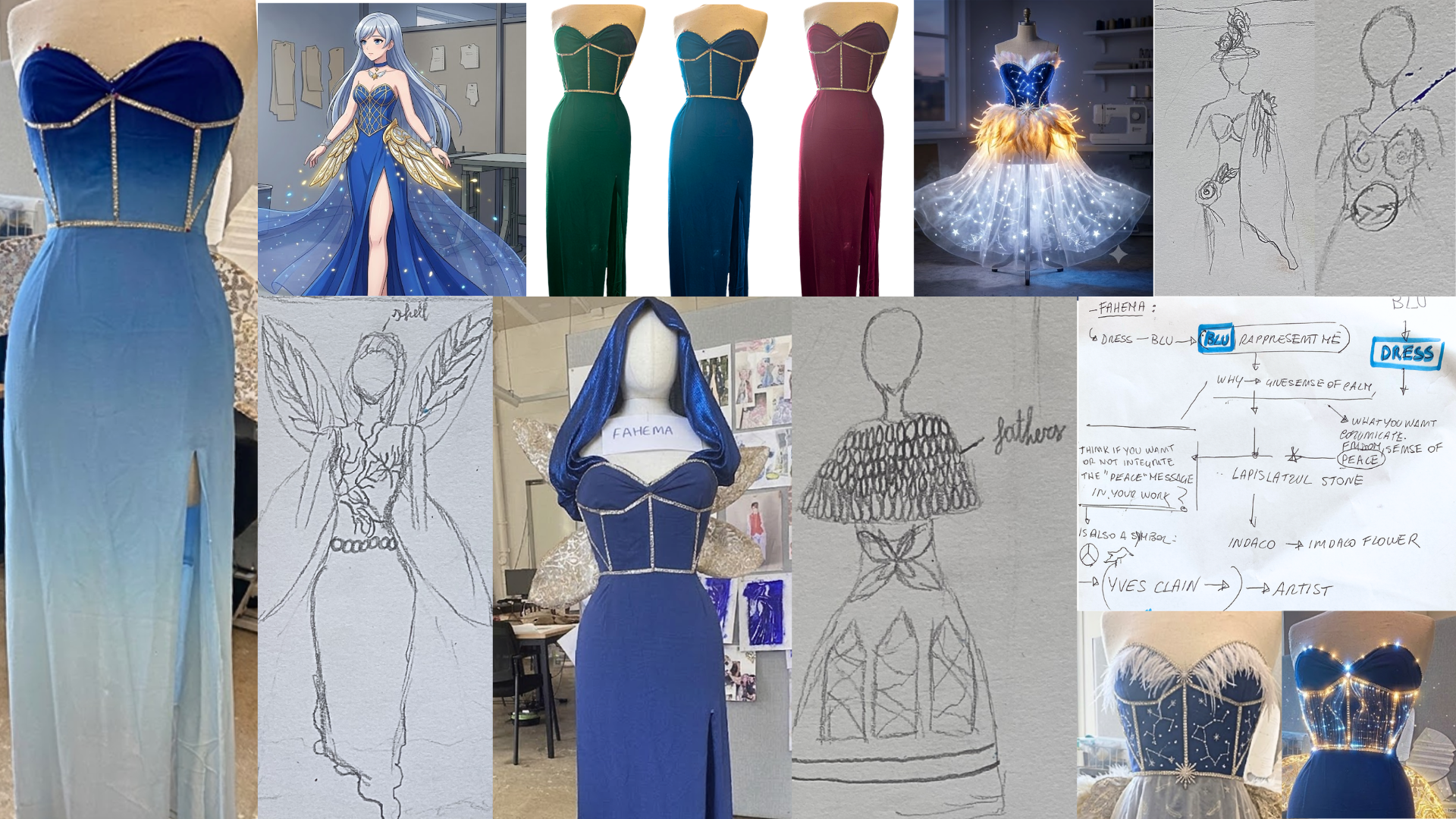
The project eventually moved towards the creation of an original animated character and the concept of “FAHEMA”, an imaginative visual identity built around an angelic aesthetic.
The glowing ombré dress became an important part of this final creative world, bringing together colour, light, fantasy and fashion.
Fahema’s project demonstrates how identity can be explored not only through direct autobiography, but also through imagination, fictional worlds and the visual cultures that inspire us.
Her Hidden Force becomes the freedom to create, combine influences and build something that feels uniquely her own.
Finding a Voice Through Art
Chitra Mani explored Hidden Forces through the theme of freedom of expression and the challenge of finding a clear, confident creative voice.
Her research included the visual language of Pop Art artist Robert Indiana and the distinctive style and cultural influence of Mick Jagger. Mick Jagger’s iconic mouth and red tongue became the central visual reference for her final artwork.
The project was originally intended to become a cushion, but a three week timeframe encouraged Chitra to rethink the idea. Instead, she transformed the concept into a canvas artwork.
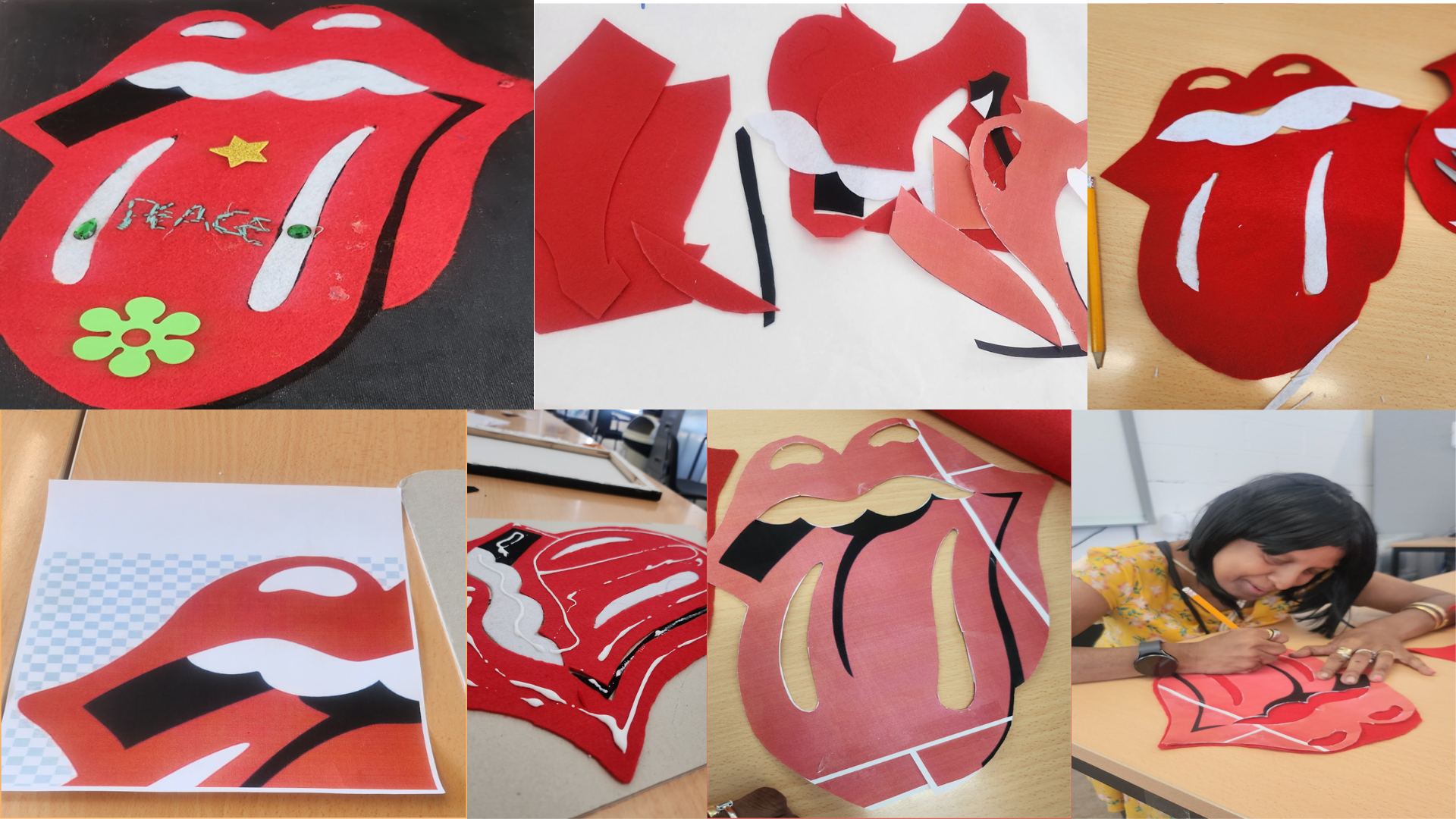
She painted the canvas black and constructed the image using white and red felt, carefully measuring and cutting individual components for the mouth, eyes and tongue. The pieces were assembled through a combination of gluing and embroidery.
Chitra then introduced her own decorative language to the work, adding an embroidered flower representing peace, green beads, a yellow star and sequins.
The project initially felt outside her comfort zone. She had never attempted a project based on this theme or worked with Mick Jagger as a subject before. Rather than allowing that uncertainty to stop her, Chitra used the experience to experiment, learn and develop her confidence.
The project has also encouraged her to think about future ways of combining art and fashion, including bringing her artwork onto fabric and continuing to participate in creative and community projects.
Her experience demonstrates that creative expression can begin with a familiar image, but ultimately become something personal through the act of making, experimenting and finding your own voice.
The final pieces are only one part of the journey.
Throughout the programme, students researched, questioned, sketched, experimented, adapted and sometimes changed direction completely. Their Learning Journals document these discoveries, showing not only what they made, but how their ideas developed along the way.
A simple starting point could become a garment, accessory, textile artwork, canvas, character or another creative fashion outcome.
What matters is not following one formula.
It is discovering your own creative language.
At Caramel Rock, we believe that creativity can give young people a powerful way to understand themselves and communicate with others.
Celebrating You creates space for young creatives to explore their identities, discover their Hidden Force, build confidence and turn their ideas into something tangible.
These projects remind us that there is no single definition of identity, creativity or success.
There are only different stories waiting to be expressed.